
Contract disputes
Disagreements over payment, performance, termination and the meaning of an agreement. We examine the contract, amendments, communications and course of performance to assess the claimed breach and resulting loss.
Ratliff Jackson LLP | Strategic Legal Advocacy for Life’s Most Critical Moments
Ratliff Jackson LLP · Civil Litigation
A broken agreement, financial loss or lawsuit can put your business, property or reputation at risk. The first step is understanding what can be proved, what relief is available and what a practical resolution would require.
Ratliff Jackson LLP represents individuals, businesses and professionals bringing and defending civil claims in New Jersey. We help clients evaluate their options, preserve evidence and move through negotiations, motions, discovery and trial when needed.
If papers have been served or a hearing is scheduled, tell us the court, service date and any deadline shown.
A viable case needs more than an unfair result. We examine the duty or agreement involved, the conduct at issue, the connection to your loss and the remedy the law permits. We also assess whether a demand, negotiation or lawsuit is a sensible next step.
A demand letter and a filed complaint require different responses. We review the allegations, service, deadlines, defenses and possible counterclaims. Where coverage may exist, we also consider notice to an insurer and its potential role in the defense.
Keep the records intact. Preserve relevant emails, messages, contracts, photographs and account information. Avoid deleting files, editing originals or posting about the dispute while the facts are being evaluated.
The legal theory, available remedies and evidence differ from one dispute to another. These practice areas provide a starting point for understanding where your matter fits.
Disagreements over payment, performance, termination and the meaning of an agreement. We examine the contract, amendments, communications and course of performance to assess the claimed breach and resulting loss.
Disputes involving business partners, company obligations, vendor relationships and alleged breaches of fiduciary duty. Governing documents and access to financial records can be central to the case.
Claims involving allegedly deceptive sales practices, misrepresentations and consumer transactions. The New Jersey Consumer Fraud Act has specific requirements for unlawful conduct, loss and causation; not every broken promise establishes a consumer-fraud claim.
Claims concerning allegedly false statements that harm a person or business. The exact words, audience, context, available defenses and evidence of harm need careful review before a demand or lawsuit.
Disputes involving funeral services, contractual obligations and alleged mishandling of remains. We examine the records, communications, responsible parties and available claims with attention to the family's circumstances.
Coverage disagreements, benefit disputes and employment-related claims may involve policy language, contracts, statutory protections or administrative steps. Identifying the governing process comes before choosing how to proceed.
Unpaid obligations and enforcement of existing judgments. A favorable ruling is only part of the analysis: available assets, lawful collection methods and the cost of enforcement affect the practical result.
Claims involving physical harm or a death require their own analysis of responsibility, causation and damages. Our related practice pages explain these matters in greater detail.
Money claims generally proceed in the Superior Court's Law Division. The Civil Part ordinarily handles claims exceeding $20,000; the Special Civil Part handles eligible claims up to $20,000, with a Small Claims Section for eligible claims up to $5,000. Requests for equitable relief may belong in the Chancery Division.
Some disputes require a court order addressing ongoing conduct, access to property or another issue that money alone may not resolve. We evaluate the appropriate division, available remedy and supporting evidence before seeking an injunction or other equitable relief.
Federal court and arbitration require a separate analysis. Federal jurisdiction must rest on a valid legal basis; the parties being in different states is not enough by itself. An arbitration or forum-selection clause can also affect where and how a dispute is heard, subject to enforceability and the applicable law.
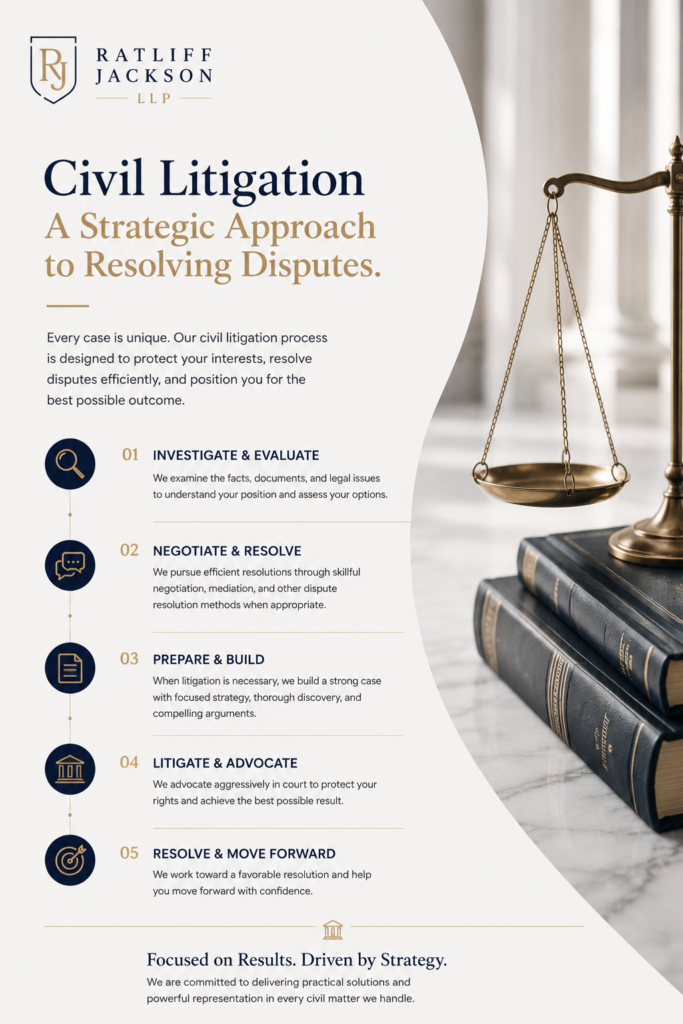
We identify the parties, relevant dates, documents, legal issues and requested outcome. Service deadlines, preservation needs, insurance notice and any potential request for emergency relief receive early attention.
We examine what each claim requires, what the existing records support and what is missing. That assessment helps determine whether to negotiate, file a complaint, respond to a lawsuit or pursue an appropriate motion.
Document requests, written questions, depositions and expert work can help establish disputed facts. We focus discovery on the issues that affect liability, damages and the ability to present or challenge the case.
We revisit settlement options in light of the record, litigation expense and your objectives. Mediation may help the parties negotiate an agreement. When the dispute remains unresolved, the next step may be a dispositive motion, arbitration or trial.
A claim's potential value is different from the amount demanded. Litigation decisions should account for the strength of the evidence, recoverable damages, available defenses, legal fees, expert costs and the ability to collect a judgment.
We consider whether the likely remedy justifies the expense and disruption of pursuing it. A useful assessment also considers insurance, available assets and whether a negotiated agreement can address the underlying problem.
We evaluate the claimed exposure, defense costs, insurance issues and consequences of settlement terms. Releases, confidentiality provisions, payment obligations and future business restrictions can matter as much as the settlement amount.
We discuss the proposed scope of representation, fee arrangement and anticipated expenses before engagement. No lawyer can promise a particular result or a fixed litigation timeline.
You do not need a perfectly organized file. Start with the records that explain the dispute and any document requiring a response.
Tell us what outcome you want and what the dispute is affecting now. Before sending sensitive records, contact the firm for appropriate submission instructions and a conflict check.
Yes. Ratliff Jackson LLP represents plaintiffs and defendants in civil disputes. For a potential claim, we assess the legal basis, evidence, available remedies and practical value of pursuing it. For a defense, we examine the allegations, response deadlines, defenses, counterclaims and potential insurance coverage.
Keep every document and record when and how you received it. Send the papers to counsel promptly, preserve relevant records and check whether an insurer needs notice. The response deadline depends on the court, proceeding and service rules. Negotiating with the other side does not, by itself, extend a court deadline.
There is no single deadline for all civil claims. The applicable law, type of claim, relevant dates and potential exceptions matter. Some disputes also involve notice requirements or contractual conditions that arise before a lawsuit. Have the timeline reviewed before relying on a general limitations period.
No. A case may resolve through negotiation, mediation, a ruling on a motion or another agreed process. If disputed issues remain, trial may be necessary. Arbitration is a separate adjudicative process that may be required by an enforceable agreement or selected by the parties.
Possibly, but winning alone does not establish a right to recover legal fees. A fee award needs an applicable legal basis, such as a statute, enforceable contract provision or court rule. We evaluate potential fee recovery and exposure separately from the underlying damages.
The cost depends on the work required, including document review, discovery, depositions, experts, motions and trial preparation. We discuss the proposed fee arrangement and anticipated expenses when evaluating representation. Those costs should be considered alongside the amount at stake and the ability to collect a judgment.
In appropriate cases, a party can request temporary or preliminary injunctive relief. The available remedy, required proof and procedure depend on the claim and court. A financial loss or urgent concern does not automatically qualify. Explain the threatened action and its timing when you contact counsel.
Our civil litigation practice serves clients throughout New Jersey. The proper county and court depend on the parties, events, claims, requested relief and any enforceable contract provisions. A case belongs in federal court only if a valid basis for federal jurisdiction exists; a dispute crossing state lines does not automatically qualify.
Discuss the facts. Understand the options.
Tell us what happened, who is involved and whether a demand, lawsuit or court deadline is pending. We can evaluate whether the matter fits our practice and discuss the next steps for potential representation.
intake@ratliffjackson.com · Terrell A. Ratliff · Samuel D. Jackson
This page provides general information, not legal advice for a particular dispute. Contacting the firm does not by itself create an attorney-client relationship.