
Professional License Defense
Professional License Defense Lawyers
Professional license defense is administrative litigation, and the credential at stake is usually the product of years of education, examination, and disciplined practice. A single complaint can place all of it at risk. Ratliff Jackson LLP defends licensed professionals in board investigations, disciplinary hearings, emergency suspension proceedings, and appeals. We represent physicians, nurses, mental health professionals, educators, pharmacists, accountants, and insurance producers before state licensing boards, with a concentrated practice before the licensing boards and administrative courts of New Jersey and Pennsylvania.
License defense follows different rules, different burdens of proof, and different procedural timelines than civil or criminal court. Boards operate under their own enabling statutes, and the decisions they issue follow a licensee across state lines through national reporting databases and interstate compacts. We approach every matter with that full picture in view: the immediate complaint, the hearing that may follow, and the downstream reporting consequences that many licensees do not see coming until the window to control them has closed.
Speak with a professional license defense attorney.
What Is at Stake in a Licensing Board Investigation
A board complaint is not a private dispute. Once an investigation opens, what you submit becomes part of an administrative record that can support formal charges, consent orders, or suspension. Discipline in one state is reported to national clearinghouses, can prompt inquiries in other jurisdictions where you hold a license, and can affect hospital privileges, insurance panel participation, employment contracts, and federal program eligibility.
The most consequential decisions in a licensing case are frequently made early, before formal charges are ever filed. How you respond to the initial inquiry, whether you sit for an investigative interview, and what you put in writing all shape the record the board will act on. New Jersey makes this concrete: a licensee who fails to respond in a timely way to an inquiry about their conduct, fails to produce records, or fails to appear at a scheduled proceeding may be found to have committed professional misconduct on that basis alone under the Uniform Enforcement Act. Silence is not a neutral option. That is why we get involved at first contact rather than after charges issue.
Medical License Defense
Physicians face board scrutiny over standard of care allegations, prescribing practices, documentation deficiencies, boundary complaints, and impairment referrals. In New Jersey, physician discipline runs through the State Board of Medical Examiners, with contested cases transmitted to the Office of Administrative Law for hearing. In Pennsylvania, the State Board of Medicine regulates physicians, physician assistants, and a range of allied practitioners under the Medical Practice Act of 1985, with prosecutions handled by Department of State counsel.
Both states authorize suspension before a full hearing. In Pennsylvania, the Board will order emergency suspension where a practitioner is alleged to present an immediate and clear danger to public health and safety, and certain convictions trigger automatic suspension by operation of statute. In New Jersey, a board may enter a temporary order suspending or limiting a license pending plenary hearing, but only where the application palpably demonstrates a clear and imminent danger to the public health, safety and welfare, and only with notice to the affected licensee. The standard is demanding, which is precisely why the response to an emergency application has to be built quickly and on the record.
Medical board discipline carries reporting consequences that extend well beyond the state that imposed it. State licensing authorities report adverse actions to the National Practitioner Data Bank, and that obligation is broader than most licensees assume. It reaches any adverse action resulting from a formal proceeding, not only revocations and suspensions, and it is not limited to final actions. A summary or emergency suspension is reportable even while the underlying case remains open. We evaluate every proposed resolution against those reporting triggers before advising a client to sign anything.
Nursing License Defense
Nursing complaints span medication errors, documentation charges, workplace conduct disputes, diversion allegations, criminal charge reporting, and positive drug screens routed into alternative to discipline programs. The New Jersey Board of Nursing and the Pennsylvania State Board of Nursing each maintain active enforcement dockets, and both states now participate in the Nurse Licensure Compact.
Pennsylvania's participation is recent and its mechanics matter. The Commonwealth fully implemented the compact on July 7, 2025. When it did, every existing Pennsylvania RN and LPN license was marked single state, and a nurse who wants multistate privileges has to apply for them affirmatively through the Board. Two consequences follow that are easy to miss. First, many Pennsylvania nurses do not hold multistate privileges even though the state is a compact member. Second, and more important in a disciplinary posture, a nurse cannot hold a multistate license while a license is encumbered, and a nurse in an alternative to discipline program becomes eligible to apply only after the program term is completed and the license is fully reinstated.
That reframes a decision nurses are often asked to make quickly. An alternative to discipline program may still be the right resolution in a given case, but it is not a consequence-free off ramp, and the effect on compact privileges belongs in the analysis before anyone signs. Board actions are also reported through Nursys, the national nursing license and discipline database. We defend nurses from the initial investigative letter through formal hearings and compact related fallout.
An arrest complicates a nursing license in ways that surprise most nurses, because criminal charges alone, before any conviction, can trigger reporting duties and open a board investigation that runs independently of the criminal case. Decisions made in the criminal proceeding can directly affect how the board evaluates fitness to practice, which is why the two matters have to be managed together rather than sequentially.
Mental Health Professional License Defense
Psychologists, professional counselors, social workers, and marriage and family therapists face a distinct category of complaints: boundary and dual relationship allegations, records and confidentiality disputes, custody evaluation grievances, and complaints filed by parties adverse to their clients in litigation. These cases turn on clinical judgment and documentation, and they require a defense that can speak the language of the profession's ethical standards while litigating the administrative record.
In New Jersey, these professions are regulated by separate boards and committees within the Division of Consumer Affairs, including the State Board of Psychological Examiners. In Pennsylvania, oversight sits with the State Board of Psychology and the companion board governing social workers, marriage and family therapists, and professional counselors. National credentialing bodies maintain their own disciplinary reporting channels, so resolution strategy has to account for both state and national exposure.
Educator License Defense
Teachers and school administrators face certification actions arising from conduct allegations, classroom management disputes, mandatory reporting issues, criminal charges, and tenure related proceedings. Educator discipline moves through a different track than health care licensing, and the procedural differences are substantial.
In Pennsylvania, educator discipline proceeds under the Educator Discipline Act before the Professional Standards and Practices Commission. The Department of Education, not the Commission, files the misconduct complaint and prosecutes it, and formal charges issue as a Notice of Charges that must set out the grounds for discipline and the supporting factual allegations with specificity. The Notice is served on the educator and on the current or prior employing school entity. Jurisdiction is broad: it reaches certificated educators regardless of current employment status or state of residence, and it extends to charter and cyber charter staff and to contracted educational providers in positions that would require certification in a traditional public school. Resigning does not remove a case from the Commission's reach. The Act also provides that where a disciplinary proceeding does not result in a finding of misconduct, the charges are to be expunged from the educator's personal and professional files maintained by the Department and the local school entity, subject to the exception for local action the school entity has taken or is pursuing.
In New Jersey, certification actions are handled through the State Board of Examiners within the Department of Education. The appeal path is not the one most educators expect. Decisions of the State Board of Examiners are appealable to the Commissioner of Education, and it is the Commissioner's decision that constitutes final agency action reviewable by the Superior Court, Appellate Division. Skipping that intermediate step forfeits the appeal.
Certification actions in both states are reported to the national clearinghouse maintained by NASDTEC, which state education agencies consult before issuing or renewing credentials. We defend the certificate itself, and we work to shape what gets reported and how it reads.
Pharmacist License Defense
Pharmacists and pharmacies operate under overlapping state and federal oversight, and complaints frequently arrive with regulatory weight behind them: dispensing errors, corresponding responsibility allegations, recordkeeping and inventory discrepancies, audit findings, and diversion investigations that can run parallel to criminal inquiries. The New Jersey Board of Pharmacy and the Pennsylvania State Board of Pharmacy each regulate individual pharmacists, pharmacy technicians, and pharmacy permits, which means a single incident can generate proceedings against the licensee and the establishment at the same time.
Pharmacy discipline also travels. Actions are shared through the clearinghouse operated by the National Association of Boards of Pharmacy, and adverse findings can affect DEA registration, wholesale relationships, and third party payer contracts. Where a matter carries parallel criminal exposure, we coordinate the administrative defense so that nothing submitted to the board undermines the client's position elsewhere.
CPA and Accountant License Defense
Certified public accountants face board action over alleged violations of professional standards, peer review findings, client complaints, criminal and tax related convictions, and reciprocal discipline following action by a federal agency or oversight body. The New Jersey State Board of Accountancy and the Pennsylvania State Board of Accountancy each hold authority over both individual licenses and firm registrations.
Pennsylvania practitioners should note a change that is still working its way into practice. Under Act 53 of 2020, Pennsylvania's licensing boards may no longer deny licensure on the basis of good moral character, crimes of moral turpitude, or ethical or dishonest practice as freestanding concepts. Each board must instead publish a schedule of criminal offenses that may constitute grounds to refuse, suspend, or revoke, and the offense must be directly related to the occupation. The implementing regulation took effect on October 19, 2024, so the framework governing conviction based discipline in Pennsylvania is newer than most published guidance reflects.
Accountancy discipline has a compounding quality. State board action can trigger proceedings before national professional bodies, and practice mobility means an adverse finding follows the practitioner into other states where they practice under mobility privileges. We defend the underlying matter and manage the reciprocal exposure as a single strategy rather than as separate problems.
Insurance Producer and Agent License Defense
Insurance producers are regulated by state insurance departments rather than professional boards, but the exposure is comparable: license revocation, civil penalties, and industry wide reporting. Enforcement actions commonly involve alleged misrepresentation, premium handling disputes, failure to disclose criminal history or prior administrative action on applications and renewals, and carrier terminations reported for cause. In New Jersey, producer licensing and enforcement run through the Department of Banking and Insurance. In Pennsylvania, the Insurance Department holds equivalent authority.
New Jersey's reporting duties deserve close attention, because there is not one clock. Under the Producer Licensing Act, a producer must report an administrative action taken in another jurisdiction or by another New Jersey governmental agency within thirty days of final disposition. A criminal prosecution in any jurisdiction must be reported within thirty days of the initial pretrial hearing date, which arrives long before any conviction. Discipline or formal disciplinary proceedings initiated by FINRA or a comparable self regulatory authority must be reported within thirty days of final disposition. Separately, a producer must notify the Commissioner within thirty days of a conviction, an indictment, the filing of formal criminal charges, or the suspension or revocation of an insurance license by another state. Failure to make these reports is itself an independent ground for discipline.
The pretrial hearing trigger is the one that catches people. A producer who intends to report at the end of a criminal case has usually already missed the deadline. Producer discipline is also nationally networked through the reporting systems maintained by the National Association of Insurance Commissioners and the licensing records accessible through the National Insurance Producer Registry. We handle both the defense and the multi state reporting obligations it triggers.
Multi-State and National Board Actions
Most licensed professionals now hold credentials in more than one state. Telehealth, interstate compacts, national mobility provisions, and remote practice have made multistate licensure routine, and disciplinary systems have adapted accordingly. Licensing statutes commonly contain a reciprocal discipline provision authorizing a board to act against a licensee based on discipline imposed elsewhere. The second proceeding is often faster and harder to defend than the first, because the sister state may treat the original order as established.
This is where resolution strategy in the first matter determines what follows. The language of a consent order, the characterization of the conduct, and the category of discipline imposed all bear on what is reported and how other jurisdictions respond. Two points are worth stating plainly. First, National Practitioner Data Bank reporting is not limited to final actions, so an emergency or summary suspension is reportable while the case is still pending. Second, surrendering a license is not a way out of the reporting system: a surrender made after notification of an investigation, or after a formal request by a licensing authority that the licensee surrender, is treated as a voluntary surrender and is itself reportable.
Federal regulations do provide a process to dispute the accuracy of information in the Data Bank, and the process has defined outcomes rather than open ended review. We represent professionals facing coordinated or sequential actions across jurisdictions, including matters involving compact privileges, Data Bank reports, and self reporting obligations in states that have not yet opened their own inquiries. The firm's attorneys are admitted in Alabama, California, Hawaii, Michigan, New Jersey, Pennsylvania, and Washington, D.C., and we structure every engagement around the client's complete licensure footprint.
How the Disciplinary Process Works
Procedural details vary by state and profession, but licensing cases in New Jersey and Pennsylvania generally move through the same sequence.
- Complaint and intake. A patient, client, employer, coworker, or agency files a complaint, or the board opens a matter on its own initiative based on a criminal charge, a malpractice report, or a data monitoring flag.
- Investigation. The board or its investigative staff requests records, conducts interviews, and may ask the licensee to appear for an investigative inquiry. In New Jersey this often takes the form of a demand letter or an invitation to appear before a committee of the board. In Pennsylvania, the Bureau of Enforcement and Investigation conducts the fieldwork for the twenty nine licensing boards and commissions supported by the Bureau of Professional and Occupational Affairs.
- Charging decision. The matter is closed, resolved informally, or escalated to formal charges. Formal charges before a Pennsylvania licensing board issue as an Order to Show Cause. In New Jersey, the charging document may be an administrative complaint or a provisional order of discipline. Pennsylvania educator cases are the exception and proceed by Notice of Charges before the Professional Standards and Practices Commission.
- Hearing. Contested New Jersey cases are transmitted to the Office of Administrative Law under the Administrative Procedure Act, where an administrative law judge conducts the hearing and issues an initial decision. Pennsylvania cases are heard by a hearing examiner or the board itself.
- Final agency action. In New Jersey, the initial decision returns to the board, which may adopt, reject, or modify it within forty five days. If the agency does not act within that window, the initial decision becomes final by operation of law. Pennsylvania boards issue final adjudication themselves.
- Appeal. New Jersey final agency decisions are reviewable by the Superior Court, Appellate Division, and the appeal must be filed within forty five days of service of the decision. Pennsylvania final adjudications are reviewable by the Commonwealth Court on a petition for review that must be filed within thirty days of entry of the order. Review in both states is deferential, which makes the record built below decisive.
The deadlines are not symmetrical, and the shorter one governs a lot of cross border practices. A professional licensed in both states who is disciplined in Pennsylvania has thirty days, not forty five.
Emergency proceedings compress this timeline substantially. Both states authorize suspension in advance of a full hearing where the board alleges danger to public health and safety, and the window to respond is measured in days rather than months.
Why Early Representation Matters
Licensing boards are not neutral forums in the way courts are. The same agency that investigates a complaint prosecutes it and ultimately decides it. Statements made in an initial response letter or an investigative interview can be used in the proceeding, and reviewing courts defer heavily to the record the board assembles. The practical consequence is that the record that decides the case is usually built during the investigation, before a hearing date exists.
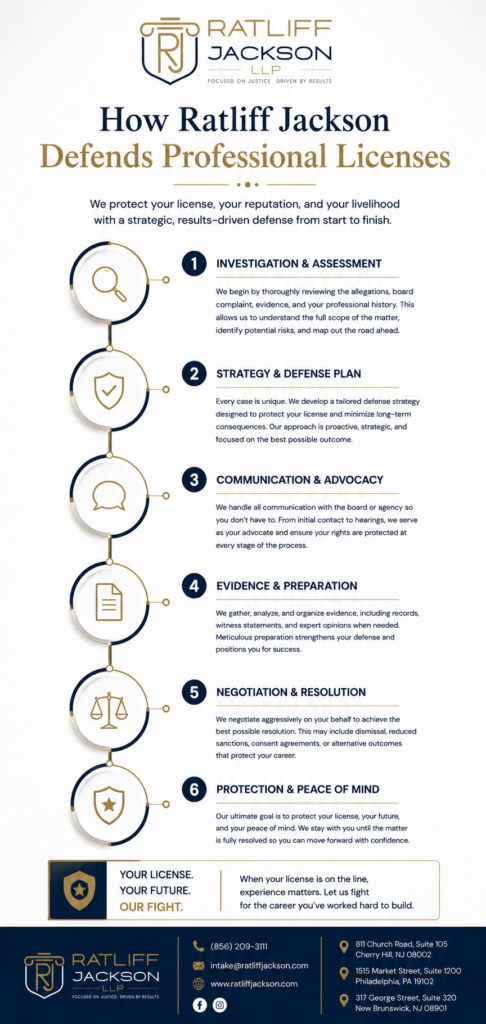
We intervene at the earliest available point: preparing the response to the initial inquiry, deciding whether and how to appear for investigative interviews, engaging board prosecutors before charges are filed, and litigating the hearing where resolution is not in the client's interest. Where settlement is the right course, we negotiate the terms that carry the longest tail, including the characterization of the conduct, the reporting consequences, and the path to restoration.
Frequently Asked Questions
General License Defense Questions
Note the response deadline, preserve every record that touches the allegation, and do not send a substantive reply before you understand what the letter is actually asking. An initial inquiry letter looks informal, but the answer becomes part of the administrative record and can support charges later. In New Jersey, ignoring it is also its own problem, because failing to respond in a timely way to a board inquiry can independently constitute professional misconduct. The right move is to respond, on time, through counsel who has read the file first.
No attorney can tell you that at the outset, and you should be cautious of anyone who offers a prediction before reading the complaint. Outcomes in licensing matters depend on the specific allegation, the documentary record, the licensee's history, the board involved, and how early the defense begins. What can be assessed early is the realistic range of outcomes and the factors that move a case within that range. That assessment is the first thing we produce.
This is the most common and most costly instinct in licensing cases. The investigator is not a neutral party gathering context, and an unprepared explanation frequently supplies detail the board did not have, concedes facts that were contestable, or creates inconsistencies with records produced later. Being innocent of the allegation does not make an unprepared statement safe. Cooperate, but prepare first.
Timelines vary widely by board and by the complexity of the allegation, and matters that appear dormant are often still open. In most cases a license remains active during an investigation, so practice continues. The exception is emergency action: both New Jersey and Pennsylvania authorize suspension in advance of a full hearing where the board alleges danger to the public, and that changes your practice status immediately rather than at the end of the case.
Treat the answer as depending on the stage and the jurisdiction. Pending complaints and investigations are generally handled differently than concluded disciplinary actions, and boards publish final actions through license verification systems and disciplinary action lookups. Separately, in health care, reporting into national systems does not depend on whether a state made the action publicly available. That distinction matters when weighing a resolution that feels private but is not.
Medical License Defense
A consent order can be the right resolution, but the phrase resolve this quietly does not describe what a consent order does. It is a disciplinary action, and state licensing authorities report adverse actions taken through a formal proceeding to the National Practitioner Data Bank. It can also be the predicate for reciprocal proceedings in every other state where you hold a license. Before signing, the questions to answer are what conduct the order recites, what category of discipline it imposes, what gets reported, and how another board will read it.
Yes, in both states, though the standard is demanding. Pennsylvania authorizes emergency suspension where a practitioner presents an immediate and clear danger to public health and safety, and provides for automatic suspension in certain circumstances defined by statute. New Jersey permits a temporary order suspending or limiting a license pending plenary hearing only where the application palpably demonstrates a clear and imminent danger to the public health, safety and welfare, and only with notice to the licensee. These matters move in days, and an emergency suspension is reportable even though the case is not over.
Usually the answer comes from your medical staff bylaws and your contracts rather than from the licensing statute, and those documents often impose disclosure duties that are triggered earlier than licensees expect. Get the bylaws and the payer and employment agreements in front of counsel at the same time as the board letter. Disclosure obligations that are missed tend to become a second, independent problem layered on the first.
Nursing License Defense
The employment matter and the licensing matter separate at that point and proceed on independent tracks. The board conducts its own investigation and is not bound by the employer's characterization of what happened. That cuts both ways: a termination does not decide the licensing case, but a settlement or separation agreement signed to resolve the employment side can contain language the board later reads as an admission. Have the licensing exposure evaluated before signing anything with the employer.
Sometimes, but the offer needs to be evaluated against consequences that are not on the face of it. One is specific and often decisive: a nurse cannot hold a multistate license under the Nurse Licensure Compact while a license is encumbered, and eligibility to apply returns only after the program term is completed and the license is fully reinstated. For a nurse who practices across state lines or by telehealth, that is a significant cost. The program may still be the better path, but it should be chosen with that in view rather than accepted as the easy option.
Multistate privileges depend on holding an unencumbered license, so action in the home state can affect the ability to practice in every other compact state at once. Board actions are shared through Nursys, the national nursing license and discipline database, so other states and employers see the action. Pennsylvania nurses should also confirm what they actually hold: the Commonwealth fully implemented the compact on July 7, 2025, and every existing Pennsylvania license was marked single state at that point, so multistate privileges exist only if the nurse applied for them.
Mental Health Professional License Defense
Yes. Boards accept complaints from any source, including parties adverse to your client in litigation, family members, and opposing evaluators, and the identity of the complainant does not determine whether the board investigates. In New Jersey, failing to respond to the inquiry can itself constitute professional misconduct. The response is where a complaint filed for strategic reasons in someone else's dispute gets framed as what it is, and that framing works best when it is made early and in writing.
This is a genuine conflict between two obligations and it should not be resolved by instinct in either direction. Producing records without authority can create a privacy exposure separate from the board matter, and withholding them can be treated as failure to cooperate. What resolves it is the legal basis for the demand, the form it takes, and what the applicable confidentiality rules permit in response to that specific instrument. Get counsel involved before the production deadline rather than after.
Boundary cases are decided on the record rather than on intent, and they frequently turn on documentation, communications, and the clinical rationale for decisions that were reasonable at the time but look different in isolation. That is why these matters reward early, organized reconstruction of the record and a defense conversant in the profession's own ethical standards, rather than a general denial.
Educator License Defense
Yes. In Pennsylvania, the Professional Standards and Practices Commission has jurisdiction over certificated educators regardless of current employment status or state of residence, so resignation does not end the certificate case and in some circumstances is what starts it. Resignation also resolves the employment matter on terms the state was not party to. If a separation is being negotiated, the certificate exposure should be evaluated before the agreement is signed rather than after.
Certification actions are reported to the national clearinghouse maintained by NASDTEC, and state education agencies consult it before issuing or renewing credentials. A surrendered or revoked certificate in one state is therefore visible to every other state that checks. Relocation is not a reset, and applying elsewhere without addressing the underlying action generally surfaces the problem rather than avoiding it.
The district controls your employment. The state controls your certificate, and therefore your ability to hold a certificated position anywhere. They run on different rules, different timelines, and different decision makers, and one can proceed after the other has concluded. Pennsylvania's Educator Discipline Act also provides that where a Commission proceeding does not result in a finding of misconduct, the charges are to be expunged from files maintained by the Department and the local school entity, subject to an exception where the school entity has taken or is pursuing its own action.
Pharmacist License Defense
A single error is evaluated in context: what happened, what harm resulted, what the records show about systems and workload, and whether the response afterward was appropriate. Boards distinguish between an isolated event and a pattern, and between an error and a failure to address one. How the incident is documented and reported internally often shapes the board matter more than the error itself.
It can, and the two proceedings do not wait for each other. Statements and records provided to a board can become available in other forums, which means the administrative response has to be built with the criminal exposure in view from the first submission rather than adjusted later. Parallel exposure also reaches federal registration and payer relationships. This is the category where responding quickly and alone does the most damage.
Both New Jersey and Pennsylvania regulate individual licensees and pharmacy permits, so one incident can generate proceedings against the person and the establishment at the same time. Roles carrying designated responsibility for compliance attract individual exposure for failures in areas assigned to that role. Where the two proceedings are related, defending them on a coordinated theory matters, because positions taken on the permit side can be used on the individual side.
CPA and Accountant License Defense
Because state boards hold independent authority over the license and commonly treat action by another authority as a basis for their own proceeding. The federal resolution does not bind the board, and the settlement language you accepted there frequently becomes the board's starting factual record. That is why the reciprocal exposure should be considered while the first matter is being negotiated, not after it closes.
Check the reporting obligation before deciding, because many licensing frameworks require disclosure on a set timeline and independently of whether the conduct relates to practice. Pennsylvania licensees should also be aware that Act 53 of 2020 changed the analysis: boards may no longer rely on good moral character or crimes of moral turpitude as freestanding grounds, and must instead apply a published schedule of offenses that are directly related to the occupation, under a regulation effective October 19, 2024. Reporting and consequence are separate questions, and the reporting duty usually comes first.
It can. Practice across state lines under mobility provisions generally depends on holding a license in good standing, and enforcement information is shared among state accountancy boards. An action in the home state can therefore reach engagements and registrations elsewhere, and it can also trigger proceedings before national professional bodies. Those consequences should be mapped before a resolution is accepted.
Insurance Producer and Agent License Defense
Treat it as the beginning of a regulatory matter rather than the end of a business relationship. Termination reporting reaches the state and enters the national producer licensing record, where other carriers and states can see it. The stated reason for the termination frequently becomes the framework for any subsequent inquiry, which is why the response is most effective when it is made close in time to the report rather than months later when a licensing question surfaces.
Nondisclosure is frequently treated as more serious than the underlying matter, because it goes to the accuracy of a filing rather than to old conduct. In New Jersey, failing to make required reports is an independent ground for discipline, and civil penalties are available. How this is corrected, and when, materially affects where it goes. Do not file a corrective disclosure without first understanding what the original filing said and what the applicable duty required.
Assume yes and verify state by state. New Jersey alone imposes several distinct duties: administrative action in another jurisdiction within thirty days of final disposition, criminal prosecution within thirty days of the initial pretrial hearing date, self regulatory discipline within thirty days of final disposition, and separate notice within thirty days of a conviction, indictment, filing of formal charges, or another state's suspension or revocation. Missing a reporting deadline converts one matter into several, and the pretrial hearing trigger is the one most often missed.
Multi-State and National Board Actions
Not automatically, but reciprocal discipline provisions are common and the second proceeding is often the harder one, because the sister state may treat the original order as established and confine the question to what discipline follows. The practical implication runs backward: the language, the recited conduct, and the category of discipline in the first order shape every proceeding after it. That is the point at which the multi state exposure is actually controlled.
No, and this is one of the most damaging misconceptions in licensing. Under the federal reporting framework, a surrender made after notification of an investigation, or after a formal request by a licensing authority that the licensee surrender, is a voluntary surrender and is reportable. Surrendering under investigation therefore generates the very record the licensee was trying to avoid, and does so without any of the defenses a contested proceeding would have preserved.
It is a federal repository of licensure actions, clinical privileges actions, and medical malpractice payments concerning health care practitioners, queried by entities authorized by statute such as hospitals, boards, and health plans rather than by the general public. Reporting is broader than many licensees expect: it covers adverse actions resulting from a formal proceeding, is not limited to revocations and suspensions, is not limited to final actions, and does not depend on the action being publicly available. Federal regulations provide a process to dispute the accuracy of a report, with defined outcomes rather than open ended reconsideration, so accuracy is best addressed before a report is generated.
Related Practice Areas
Resources
The agencies, statutes, and reporting systems below govern professional licensing and discipline for the professions we defend. If you are researching your own matter, these are the primary sources: the authority that holds your file, the rules that govern the proceeding, and the national systems where disciplinary actions are recorded and shared.
New Jersey
- New Jersey Uniform Enforcement ActThe statute governing investigative powers, grounds for discipline, and penalties across New Jersey's professional and occupational boards.
- N.J.S.A. 45:1-22, Temporary Suspension AuthorityThe provision authorizing a temporary order suspending or limiting a license pending plenary hearing, and the standard that must be met.
- Licensee Duty to CooperateThe uniform regulations defining what conduct is deemed failure to cooperate with a board inquiry, and the consequences that follow.
- New Jersey Department of Education, Legal ProcessesExplains the contested case process and the appeal route for State Board of Examiners decisions through the Commissioner.
- New Jersey Appellate Division, Appeals GuideFiling requirements and deadlines for appeals from final agency decisions to the Superior Court, Appellate Division.
Pennsylvania
- Bureau of Professional and Occupational AffairsThe Department of State bureau supporting Pennsylvania's twenty nine licensing boards and commissions, including enforcement and prosecution.
- Pennsylvania Boards and CommissionsDirectory of the individual licensing boards, each operating under its own enabling statute and regulations.
- Pennsylvania Licensing SystemVerify a Pennsylvania license and check whether a licensee has been subject to disciplinary action.
- Act 53 of 2020 Best Practices GuideThe Department of State guide to how criminal convictions may be used in licensing decisions, under the regulation effective October 19, 2024.
- Pennsylvania Nurse Licensure Compact InformationBoard guidance on multistate licensure, including the single state default applied at implementation and eligibility after reinstatement.
- Educator Discipline System and Mandatory ReportingThe Professional Standards and Practices Commission's explanation of jurisdiction, complaint review, and the discipline process for educators.
- Commonwealth Court, Petition for ReviewFiling requirements and the thirty day deadline for seeking review of a Pennsylvania agency decision.
National Reporting Systems
- 45 CFR Part 60, National Practitioner Data BankThe federal regulations establishing what must be reported, who may query, and the process for disputing the accuracy of a report.
These resources are provided for general reference and are not legal advice. If a licensing board, department, or reporting entity has contacted you, speak with an attorney before responding.
Speak With a Professional License Defense Attorney
If you have received a board complaint, an investigative letter, a subpoena for records, or notice of an emergency suspension, the decisions made in the next several days will shape the rest of the case. Do not respond to the board, sit for an interview, or sign anything before you understand the consequences.
Confidential consultation with Ratliff Jackson LLP.
Other Practice Areas of Employment law