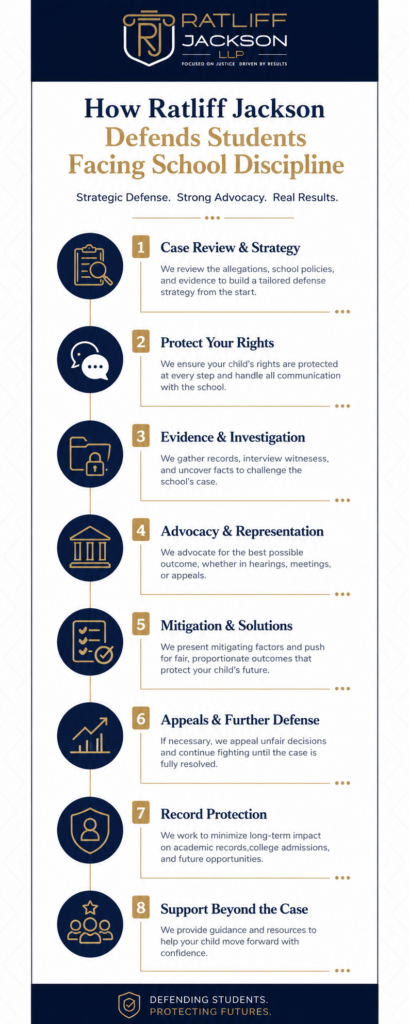

Student Discipline Defense Lawyers: Defending Students Protecting Futures
New Jersey Student Discipline Defense Lawyers
A school disciplinary charge is a legal problem with legal consequences. A suspension, expulsion, or misconduct finding can alter a student's transcript, scholarship eligibility, admissions prospects, and professional licensing path for years after the hearing ends. At Ratliff Jackson LLP, our student discipline defense lawyers represent K-12 students, college and university students, and graduate and professional students throughout New Jersey in disciplinary investigations, hearings, and appeals. We intervene early, control the record, and hold institutions to the procedures the law requires of them.
A disciplinary notice usually comes with a deadline measured in days. Call (856) 209-3111 or email intake@ratliffjackson.com before you respond to the school.
Allegations We Defend
Our student discipline defense practice covers the full range of conduct and academic charges schools bring, including:
- Suspension and expulsion, including suspension challenges and expulsion appeals
- Academic integrity charges, including plagiarism allegations, cheating, unauthorized collaboration, and other academic integrity violations
- Title IX matters, including sexual misconduct, harassment, and dating violence allegations, handled through our Title IX defense practice
- Behavioral violations, including threats, fighting, hazing, bullying, and vandalism
- Drug, alcohol, and vaping allegations, including possession and distribution charges on campus
- Social media and off-campus conduct that schools claim disrupts the educational environment, addressed through our social media discipline practice
- Weapons allegations and school lockdown incidents
- Special education discipline involving IEPs and Section 504 plans, handled through our special education discipline practice
- Formal proceedings at every stage, from misconduct investigations through disciplinary hearings
These cases move quickly. Students are often removed from class within hours of an allegation, pressed for written statements before understanding the charge, and scheduled for hearings before they have seen the evidence. Early legal intervention slows the process and protects the record.
The New Jersey Legal Framework Governing School Discipline
School discipline in New Jersey is not left to administrator discretion. Public school authority to suspend or expel is defined by statute, and the procedures districts must follow are set by administrative code.
N.J.S.A. 18A:37-2 establishes the conduct that constitutes good cause for suspension or expulsion, from willful disobedience and assault to property offenses. The statute defines the outer boundary of district authority. Conduct that does not fall within it is a point of leverage for the defense.
N.J.A.C. 6A:16 sets the procedural rules districts must follow, including code of conduct requirements, short-term and long-term suspension procedures, and the due process obligations that attach at each stage. Districts that skip steps, provide defective notice, or deny required hearings expose their own decisions to reversal.
The appeal path is layered. Long-term suspension and expulsion decisions run through the superintendent and the local board of education. Board decisions can be appealed to the Commissioner of Education, and contested cases are heard before the New Jersey Office of Administrative Law. Each level has its own filing deadlines and standards. Missing one forfeits it.
Where school discipline intersects with juvenile charges or police involvement, we coordinate defense across both tracks alongside our juvenile defense practice so that statements made in one proceeding do not damage the other.
How We Defend Students
Step 1: Situational assessment. On the first call we identify what the school alleges, what rule or statute it relies on, what stage the process has reached, and where the procedural vulnerabilities are.
Step 2: Control the record. Students damage their own cases by speaking too early. We manage all written responses, statements, and communications with school officials, and we demand access to the evidence file, the disciplinary code, and every document the decision-maker will see.
Step 3: Strategic positioning. We determine whether to contest the charge, negotiate a resolution, or prepare for a contested hearing. That includes drafting rebuttals, preparing witnesses, challenging biased panel members, and pressing procedural objections that preserve appeal rights.
Step 4: Long-term protection. The hearing is not the end of the case. We pursue record expungement, negotiate transcript notations, manage education record requests, and advise on disclosure obligations for transfer, graduate, and professional applications.
K-12 Discipline: Constitutional and Statutory Protections
Public school students facing suspension have federal due process rights under Goss v. Lopez, which requires notice of the charges and an opportunity to respond before removal in most circumstances. New Jersey law builds additional procedure on top of that constitutional floor, particularly for suspensions beyond ten days and expulsions.
Students with disabilities have further protections. The Individuals with Disabilities Education Act and Section 504 require manifestation determination reviews before schools may impose long-term removal for conduct connected to a student's disability. Districts frequently get this analysis wrong, and a flawed manifestation determination is among the strongest grounds for unwinding a disciplinary removal.
We represent K-12 students in superintendent hearings, board of education appeals, manifestation determination reviews, and emergency removal challenges.
College and University Discipline: A Different Set of Rules
Campus disciplinary boards do not operate like courts. The institution selects the hearing format, sets the evidentiary rules, and often limits what an attorney may say in the room. At public institutions, students retain constitutional due process rights. At private institutions, the student handbook and enrollment agreement function as a contract, and contractual fairness obligations are enforceable when schools violate their own published procedures.
We know how to operate inside these constraints. Whether serving as an advisor in a Title IX proceeding, preparing a student for questioning, or building the procedural record that supports a later appeal or lawsuit, the preparation standard does not change. We represent undergraduates, graduate students, and students in medical, law, and other professional programs, where a single finding can trigger separate fitness and licensure consequences.
What a Disciplinary Finding Actually Costs
Schools describe discipline as an internal matter. The record says otherwise. A Title IX finding can surface in graduate school admissions and employment screening. An academic integrity finding can block scholarship renewal and transfer. Disciplinary records can be subpoenaed in later legal proceedings, and some K-12 matters draw police or DCPP involvement. Education records carry federal privacy protections under FERPA, but those protections have exceptions, and schools share more than families expect unless rights are asserted early and in writing.
Why Families Retain Ratliff Jackson LLP
Litigation capability behind every case. We do not only know school policy. We know how to challenge it before the board, the Commissioner, the Office of Administrative Law, and in court when the school leaves no alternative.
Direct communication. Families never go days without an update. These cases move fast, and our clients know where their case stands at every stage.
Discretion. Disciplinary matters carry reputational weight for students and families. We manage them accordingly.
Frequently Asked Questions
Yes. Most institutions permit an advisor of choice to attend, even where they restrict direct participation. A student discipline defense lawyer prepares the student, monitors the proceeding for procedural violations, and builds the record that supports an appeal if the outcome is wrong.
Immediately, and before the student gives any statement. Early involvement shapes the written record, prevents unforced errors, and preserves procedural objections that are waived if not raised in time.
Most codes allow the school to proceed without the student, which frequently produces a default finding of responsibility. The correct response is a timely, counsel-managed reply that requests extensions or accommodations where needed.
Often, yes. Where the evidence is thin or the school skipped required procedure, charges can be withdrawn or reduced before a hearing is ever held. Negotiated resolutions such as probation in place of suspension are also available in many first-offense and low-intent cases.
Yes. Interim removal is supposed to be reserved for genuine safety risks, and most codes provide a mechanism to contest it. We move quickly to challenge interim suspensions so the student is not serving a penalty before any finding exists.
It varies by institution and by sanction. Some schools place notations on transcripts; others keep findings in internal records that are disclosed on inquiry. Counsel can negotiate notation language, pursue expungement or removal after a successful appeal, and confirm exactly what future institutions will see.
Detection tools, including AI-writing detectors, misread common phrasing, citation formats, and drafting history. We challenge the reliability of the flag itself, using originality reports, version history, and drafting evidence to show authorship.
FERPA limits parental access to a college student's records without the student's consent. With properly executed consent forms, counsel can keep parents informed and involved while respecting the privacy rules the school must follow.
Schools increasingly reach off campus, particularly for online conduct, but their jurisdiction has limits. We challenge overreach by holding the school to its own code language and to the required connection between the conduct and the educational environment.
Parallel proceedings are dangerous because statements in the school matter can be used in the criminal matter. We coordinate strategy across both tracks, and with juvenile or criminal defense counsel where appropriate, so the student is protected in each forum.
Yes. Appeals may rest on procedural violations, new evidence, or sanctions disproportionate to the finding. In New Jersey public schools, the path runs from the board of education to the Commissioner of Education, with contested cases heard at the Office of Administrative Law. Appeal windows are short and strictly enforced.
An admission made under pressure, or without understanding the consequences, is not always the end of the case. Depending on the code and the circumstances, counsel can seek to withdraw the admission, contest the sanction, or raise the coercion on appeal.
Student Discipline Defense Practice Areas
- Title IX Defense
- Code of Conduct Advisor
- Academic Integrity Violations
- Plagiarism Allegations
- Disciplinary Hearings
- Expulsion Appeals
- Suspension Challenges
- Special Education Discipline
- Misconduct Investigations
- Social Media Conduct Cases
- Student Protest and Free Speech Defense
- Discrimination Claims Defense
- Teacher-Student Boundary Allegations
- Campus Safety Violations
- School Residency Fraud Accusations
- Residency Disputes
- Scholarship Revocation Appeals
- Graduate School Misconduct
- Professional Program Expulsions
Our education practice extends beyond discipline. For the full scope of school-related representation, visit our New Jersey education lawyers hub. Families researching the disciplinary process can also review our resources on academic dishonesty defense, Title IX representation, and school no-contact orders.
Resources
Primary legal sources referenced on this page, for families who want to review the governing law directly:
- N.J.S.A. 18A:37-2 – Causes for suspension and expulsion of pupils in New Jersey public schools
- N.J.A.C. 6A:16 – New Jersey administrative code governing student conduct, suspension, and expulsion procedures
- Goss v. Lopez, 419 U.S. 565 (1975) – U.S. Supreme Court decision establishing due process rights in public school suspensions
- Individuals with Disabilities Education Act – Federal discipline protections for students with disabilities, including manifestation determination requirements
- FERPA – Federal law governing the privacy and disclosure of education records
- New Jersey Office of Administrative Law – Forum for contested education appeals following board of education decisions
The strongest defenses are built before the first statement is made. Call (856) 209-3111 or email intake@ratliffjackson.com to speak with a student discipline defense lawyer today.
Other Practice Areas of Student Defense
- Title IX Advisor
- Code of Conduct Advisor
- Academic Dishonesty Advisor
- Academic Integrity Violations
- Plagiarism Allegations
- Disciplinary Hearings
- Expulsion Appeals
- Suspension Challenges
- Special Education Discipline
- Bullying and Harassment Defense
- Residency Disputes
- School Residency Fraud Accusations
- Misconduct Investigations
- Teacher-Student Boundary Allegations
- Campus Safety Violations
- Social Media Conduct Cases
- Student Protest and Free Speech -Defense
- Discrimination Claims Defense
- FERPA Violation Allegations
- Scholarship Revocation Appeals
- Graduate School Misconduct Cases
- Professional Program Expulsions