Funeral home litigation
Pennsylvania Funeral Home Lawsuit Lawyers
Families who bring a funeral home lawsuit in Pennsylvania are usually confronting a wrong that cannot be undone. When a funeral home breaks that trust through negligence, fraud, or the mishandling of a loved one's remains, Pennsylvania law provides real remedies, not only an apology or a refund. At Ratliff Jackson LLP, we represent families across Pennsylvania against funeral homes, crematories, cemeteries, and funeral establishments, pursuing the negligence, contract, emotional-distress, and statutory claims that hold these providers accountable. These cases require both legal precision and discretion, and we handle them with both.
Evidence in these cases can disappear quickly, and Pennsylvania's filing deadlines can be shorter than families expect. Call (856) 209-3111 or email intake@ratliffjackson.com to discuss what happened.
When You May Have a Claim
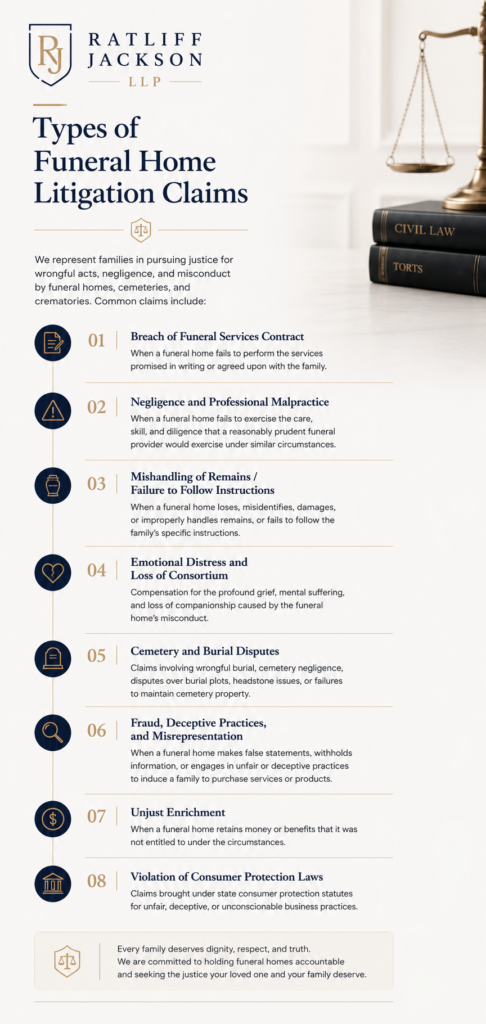
A funeral home, crematory, or cemetery can be held responsible when it violates state licensing rules, professional standards, or its contract for services. Common grounds for a claim include:
- Mishandling, losing, or misidentifying remains
- Cremation errors, including commingling or loss of ashes
- Improper embalming, preparation, or storage
- Failure to follow the family's written instructions or religious requirements
- Burial in the wrong plot, or disposition contrary to the authorized person's direction
- Damage to caskets, urns, personal items, or burial sites
- Unlicensed or unqualified staff performing regulated services
- Fraudulent billing, undisclosed charges, or fees for goods and services never provided
Not every complaint rises to a lawsuit, and part of our role is to tell you candidly which facts support a claim and which do not. Where the conduct did cause real harm, several distinct legal theories may apply at once.
The Legal Claims Behind a Funeral Home Lawsuit
A Pennsylvania funeral home lawsuit usually involves more than one cause of action, and the combination matters because each carries different proof requirements, damages, and deadlines:
- Negligence. Failure to handle remains or provide services with the care the law and professional standards require.
- Breach of contract. Failure to deliver the services the family paid for under the funeral services agreement.
- Mishandling of remains and emotional distress. Pennsylvania recognizes a distinct cause of action for the mishandling of a corpse that causes mental suffering. The Pennsylvania Supreme Court affirmed this in Papieves v. Kelly, 437 Pa. 373 (1970), adopting the principle that a family member entitled to control disposition may recover for the intentional or negligent interference with a decedent's body. Claims for intentional infliction of emotional distress are also available where the conduct was extreme and outrageous.
- Consumer protection. Deceptive billing or misrepresentation about goods and services can support a claim under Pennsylvania's Unfair Trade Practices and Consumer Protection Law, which allows for enhanced remedies in appropriate cases.
- Statutory and regulatory violations. A breach of the rules that govern funeral directors can serve as evidence of the standard of care and its violation.
Where a provider's conduct caused the wrongful handling or burial of a loved one, the matter can also intersect with a wrongful death or breach of contract claim, and we evaluate every available theory rather than the most obvious one.
Who Has the Legal Right to Control the Remains
Many funeral home disputes turn on a single question: who had the legal authority to direct the disposition of the remains. Pennsylvania answers that question by statute. Under 20 Pa.C.S. § 305, a surviving spouse generally holds primary authority over disposition, and in the absence of a spouse that authority passes to the next of kin. The statute allows a person to be challenged on specific grounds, including enduring estrangement, incompetence, a decedent's contrary intent, or a waiver, each of which must be proven by clear and convincing evidence. Where people of equal standing disagree, the statute provides a court process, including an expedited petition to halt disposition while the dispute is resolved. Establishing who held the right to control disposition, and what they directed, is often the first decisive issue in the case, both for families pursuing a claim and for providers defending one.
How Pennsylvania Regulates Funeral Providers
Funeral directors and establishments in Pennsylvania are licensed and regulated by the State Board of Funeral Directors within the Department of State, under the Funeral Director Law, 63 P.S. §§ 479.1 through 479.20. Those rules govern licensing, the handling and preparation of remains, recordkeeping, escrow of prepaid funeral funds, and billing. Funeral providers are also bound by the Federal Trade Commission's Funeral Rule, which requires itemized price disclosures and prohibits certain billing practices. A violation of these standards does two things for a family: it can support a complaint to the Board through the Bureau of Professional and Occupational Affairs, and it can serve as evidence of negligence in a civil lawsuit. The two tracks are separate, but they can reinforce each other when handled together.
Deadlines: Why Timing Is Critical
Pennsylvania funeral home claims do not share a single deadline, and the shortest one controls whichever claim it applies to. Negligence, emotional-distress, and wrongful death claims generally must be filed within two years under 42 Pa.C.S. § 5524. Breach-of-contract claims generally allow four years under 42 Pa.C.S. § 5525. Pennsylvania's four-year contract deadline is shorter than the equivalent deadline in some neighboring states, so families should not assume the timeline is generous. Because these windows differ and the shortest one governs its claim, any potential claim should be reviewed promptly so that no available theory is lost to the calendar.
How We Handle These Cases
Building a funeral home case is an evidence problem before it is a courtroom problem. We move quickly to preserve and demand the records that decide these matters: the funeral services contract, itemized billing, staff licensing, burial and cremation permits, and cemetery and crematory records. We work with forensic and mortuary-science experts where the facts require it, handle pre-litigation demands and Board complaints, and litigate through trial when a provider will not account for what happened. Throughout, we manage the process with the discretion these matters demand, resolving through confidential negotiation or mediation where that serves the family and filing publicly where it does not.
For answers to common questions in a shorter format, you can also watch our funeral home litigation FAQ videos. If your matter arises in New Jersey rather than Pennsylvania, see our New Jersey funeral home lawsuit page.
Frequently Asked Questions
Yes. Pennsylvania recognizes a specific cause of action for the mishandling of a corpse that causes mental suffering, alongside claims for negligence and breach of contract. Whether a particular set of facts supports a claim depends on the conduct and the harm, which is what an early case review determines.
Emotional distress is recoverable in these cases. Pennsylvania law, through Papieves v. Kelly and the principle it adopted, allows a family member entitled to control disposition to recover for mental suffering caused by mishandling of remains. Economic losses such as corrective burial or cremation costs and refunds may also be recovered, and additional remedies are possible where the conduct was extreme and outrageous.
It depends on the claim. Negligence and emotional-distress claims generally run two years from the injury or its discovery under 42 Pa.C.S. § 5524. Breach-of-contract claims generally allow four years under 42 Pa.C.S. § 5525. Because the deadlines differ and the shortest one governs its claim, prompt review matters.
Under 20 Pa.C.S. § 305, a surviving spouse generally holds primary authority, and in the absence of a spouse it passes to the next of kin. That authority can be challenged on specific grounds such as enduring estrangement or a decedent's contrary intent, proven by clear and convincing evidence, and disputes among people of equal standing are resolved by the court. Who held that authority, and whether the funeral home honored it, is central to many of these cases.
Yes. Funeral directors and establishments are licensed and regulated by the State Board of Funeral Directors within the Pennsylvania Department of State, under the Funeral Director Law, and are also subject to the FTC Funeral Rule. A licensing or disclosure violation can support both a Board complaint and a civil claim, though a complaint to the Board is separate from a lawsuit and does not by itself compensate the family.
Some matters resolve confidentially through negotiation or mediation. When litigation is necessary, court filings are generally public, but sensitive family details can often be protected. We discuss the privacy implications with every family before proceeding.
Civil Litigation Practice Areas
- Civil Litigation Overview
- Funeral Home Lawsuits (New Jersey)
- Consumer Fraud
- Breach of Contract
- Wrongful Death
- Defamation
- Collections
Funeral home matters frequently overlap with other civil claims. For related work, see our civil litigation practice and wrongful death pages.
Resources
Primary legal sources referenced on this page:
- Funeral Director Law, 63 P.S. §§ 479.1 et seq. – Pennsylvania statute governing funeral directors and the State Board of Funeral Directors
- 20 Pa.C.S. § 305 – Right to dispose of a decedent's remains and resolution of disputes
- 42 Pa.C.S. § 5524 – Two-year limitation for negligence and related claims
- 42 Pa.C.S. § 5525 – Four-year limitation for breach-of-contract claims
If a funeral home, crematory, or cemetery has mishandled your loved one's remains or failed your family in Pennsylvania, you have rights, and the deadline to act may be short. Call (856) 209-3111 or email intake@ratliffjackson.com to discuss your options.
Other Practice Areas of Civil Litigation
- Consumer fraud
- Breach of contract
- Funeral home litigation
- Collections
- Automobile Accidents
- Motorcycle Accidents
- Truck Accidents
- Bicycle Accidents
- Pedestrian Accidents
- Slip and Fall Accidents
- Medical Malpractice
- Nursing Home Abuse
- Product Liability
- Premises Liability
- Dog Bites
- Construction Accidents
- Workplace Injuries
- Wrongful Death
- Boating Accidents
- Aviation Accidents
- Toxic Exposure
- Defamation
- Assault and Battery
- Sports Injuries