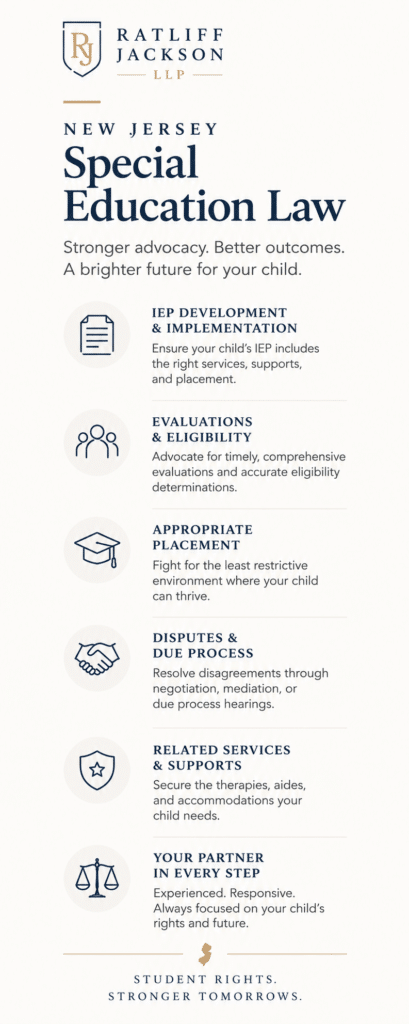

Special Education Law
New Jersey Special Education Lawyers
Every child with a qualifying disability in New Jersey has the right to a free appropriate public education, and when a district falls short, families have real legal tools to enforce it. At Ratliff Jackson LLP, our New Jersey special education lawyers represent parents through the entire process, from a first evaluation request through the individualized education program, and into mediation, due process, and court when a district will not provide what the law requires. Special education is procedural by design, and knowing the timelines and the leverage points is what turns a parent's concern into an enforceable result.
Special education timelines run on strict deadlines, and rights are lost when they pass. Call (856) 209-3111 or email intake@ratliffjackson.com to speak with a New Jersey special education lawyer.
The Right to a Free Appropriate Public Education
Two federal laws set the foundation. The Individuals with Disabilities Education Act guarantees eligible students a free appropriate public education, known as FAPE, delivered through an individualized education program. Section 504 of the Rehabilitation Act separately protects students with disabilities from discrimination and can require accommodations even for students who do not qualify for an IEP. New Jersey implements and expands on these federal rights through its special education code, N.J.A.C. 6A:14, which governs how districts must identify, evaluate, serve, and, when necessary, discipline students with disabilities. A district's obligations under that code are specific and time-bound, and most successful special education cases are built on the points where a district failed to meet them.
Evaluation and Eligibility
Special education begins with an evaluation, and the process carries deadlines that districts frequently miss.
The 90-day timeline
Under N.J.A.C. 6A:14-3.4, once a parent provides written consent for an initial evaluation, the district must complete the evaluation, determine eligibility, and, if the student is eligible, develop and implement the IEP within 90 calendar days. A parent does not need to wait for the school to act, and a written request is what starts the clock. Districts that let this deadline slip are exposed, and that exposure is often the first source of leverage in a case. The evaluation itself is conducted by a multi-disciplinary child study team, with at least one evaluator knowledgeable in the area of the suspected disability.
The three-part eligibility test
Eligibility under N.J.A.C. 6A:14-3.5 is not a single judgment call. To qualify, a student must have a disability that fits one of the recognized eligibility categories, the disability must adversely affect educational performance, and the student must require special education and related services as a result. Districts sometimes deny eligibility by treating a student who earns passing grades as not affected, but academic survival is not the standard. When a district gets the analysis wrong, that decision can be challenged.
The right to an independent evaluation
If a parent disagrees with the district's evaluation, N.J.A.C. 6A:14-2.5 gives them the right to an independent educational evaluation at the district's expense, one per district evaluation. The request should be made in writing and state that the parent disagrees with the district's assessment. An independent evaluation must be considered by the district and can be presented as evidence in a due process hearing, which makes it one of the most useful tools available to a family early in a dispute.
The Individualized Education Program
The IEP is the written, enforceable plan that defines a student's goals, services, placement, and accommodations. It is not aspirational language; a district must implement what the IEP says, and a failure to deliver listed services is itself a violation. The IEP must be reviewed at least annually, and the student must be reevaluated at least once every three years unless the parent and district agree otherwise. When a district writes an appropriate IEP but does not follow it, or writes an inadequate one that does not confer meaningful benefit, families can pursue a FAPE dispute and seek compensatory education for the services the student was denied.
Least Restrictive Environment
Federal and state law require that students with disabilities be educated, to the maximum extent appropriate, alongside their non-disabled peers. Removal to a separate setting is permitted only when the nature of the disability is such that education in the general classroom, even with supplementary aids and services, cannot be achieved satisfactorily. Districts sometimes segregate students for convenience rather than necessity, or fail to provide the supports that would make an inclusive placement work. These are least restrictive environment violations, and they are challengeable.
Section 504 Plans and Accommodations
Not every student with a disability needs an IEP, but many still need accommodations to access their education. A Section 504 plan can provide those accommodations, from extended time to assistive technology to physical access, for students whose disability substantially limits a major life activity. Section 504 also protects students from disability-based discrimination independent of the IEP process. We help families secure and enforce 504 plan compliance and appropriate disability accommodations.
When the District Gets It Wrong: Dispute Resolution
New Jersey provides several routes to resolve a special education dispute, and choosing the right one is a strategic decision:
- Mediation. A voluntary process with a state-assigned mediator, often faster and less adversarial than a hearing.
- Due process. A formal administrative hearing before an administrative law judge at the New Jersey Office of Administrative Law, governed by N.J.A.C. 6A:14-2.7. A due process petition generally must be filed within two years of when the parent knew or should have known of the issue, which is why early action matters.
- Emergent relief and stay-put. While a dispute is pending, a student generally remains in the current placement, a protection known as stay-put that prevents a district from unilaterally changing services during the fight.
Depending on the case, remedies can include compensatory education, a corrected IEP or placement, reimbursement for a private placement the district should have provided, and, in due process, an order compelling the district to act. We also handle due process hearings from the resolution session through the decision and any appeal.
Discipline and Students With Disabilities
Students with disabilities have protections that general discipline rules do not provide. Before a removal that amounts to a change in placement, the district must conduct a manifestation determination review to decide whether the conduct was a result of the disability or of the district's failure to implement the IEP. If it was, standard discipline generally cannot proceed. For the full disciplinary process, including suspensions, expulsions, and hearings, see our student discipline defense practice.
Frequently Asked Questions
In New Jersey, once you give written consent for an initial evaluation, the district has 90 calendar days to complete the evaluation, determine eligibility, and, if your child qualifies, develop and implement the IEP. Put your request in writing, because that is what starts the clock, and districts frequently miss this deadline.
Not by itself. Eligibility depends on whether a disability adversely affects educational performance and requires specialized instruction, not on whether the student is passing. A child can earn acceptable grades and still qualify, particularly where they are compensating in ways that mask the disability. This kind of denial can be challenged.
You have the right to an independent educational evaluation at the district's expense, one per district evaluation, when you disagree with the district's assessment. Make the request in writing and state that you disagree. The district must consider the independent evaluation, and it can be used as evidence if the matter goes to due process.
Yes. A district must implement the IEP as written, and a failure to deliver listed services or accommodations is a violation in itself. Keep records of missed services, and counsel can file for mediation or due process to compel compliance and seek compensatory education for what your child was denied.
Generally two years from the date you knew or should have known about the issue that forms the basis of the dispute. Because that window can be shorter than families expect and evidence fades over time, it is best to have a potential claim evaluated promptly rather than waiting.
Generally no. Under the stay-put protection, a student remains in the current educational placement while a due process proceeding is pending, unless the parties agree otherwise. This prevents a district from unilaterally reducing or changing services during the dispute.
Sometimes. Where a district fails to provide FAPE and a parent places the student in an appropriate private program, reimbursement may be available. These cases have specific notice requirements and turn on whether the district's program was inadequate and the private placement appropriate, so they should be handled with counsel from the outset.
Yes. Before a removal that changes placement, the district must hold a manifestation determination review to decide whether the behavior was a result of the disability or a failure to implement the IEP. If it was, ordinary discipline generally cannot be imposed. We handle these reviews and the broader disciplinary process.
Related Special Education Services
- Evaluation and Eligibility Disputes
- FAPE Disputes
- LRE Violations
- 504 Plan Compliance
- Disability Accommodations
- Due Process Hearings
- Manifestation Determination Reviews
- Private Placement Reimbursement
- Transition Planning
This page is part of our broader New Jersey education law practice.
Resources
Primary legal sources referenced on this page:
- Individuals with Disabilities Education Act – Federal law guaranteeing a free appropriate public education
- N.J.A.C. 6A:14-3.4 – New Jersey evaluation procedures and the 90-day timeline
- N.J.A.C. 6A:14-2.7 – New Jersey special education due process hearing procedures
- Parental Rights in Special Education (PRISE) – New Jersey Department of Education parental rights handbook
If your child has been denied an evaluation, found ineligible, given an inadequate IEP, or removed from an appropriate placement, the time to act is now. Call (856) 209-3111 or email intake@ratliffjackson.com to speak with a New Jersey special education lawyer.
Other Practice Areas of Education
- Special Education Law
- Title IX Compliance
- Discipline and Expulsion
- Bullying and Harassment
- Student Rights
- Teacher Rights
- School Governance
- Higher Education Law
- Disability Accommodations
- IEP Development and Implementation
- 504 Plan Compliance
- Due Process Hearings
- Mediation for Special Education Disputes
- Manifestation Determination Reviews
- Least Restrictive Environment (LRE) Issues
- Free Appropriate Public Education (FAPE) Disputes
- Transition Planning for Students with Disabilities
- Assistive Technology Access
- Private School Placement Reimbursement
- Evaluations and Assessments Disputes
- Charter School Law
- Private School Law
- Public School Law
- FERPA Compliance
- Academic Integrity Issues
- Discrimination Claims
- School Funding Disputes
- Curriculum Challenges
- School Safety Policies
- Standardized Testing Issues
- College Admissions Disputes