Education Lawyers
Pennsylvania Education Lawyers
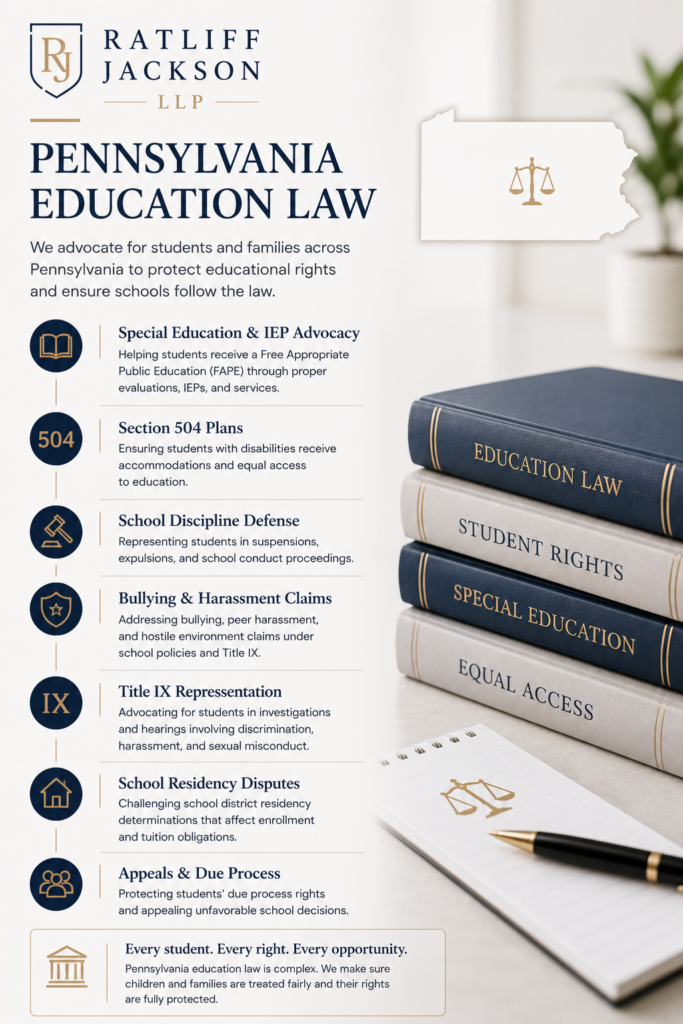
When a school, district, or university fails a student, families need Pennsylvania education lawyers who understand both the state's administrative system and the federal law layered on top of it. At Ratliff Jackson LLP, we represent students and parents across the range of education law: special education and Section 504, school discipline, Title IX, bullying and discrimination, higher education proceedings, and the records and civil rights disputes that surround them. Education matters move on short deadlines and through unfamiliar procedures, and the earlier a family has counsel, the more can be done.
Education disputes often carry filing windows measured in days. Call (856) 209-3111 or email intake@ratliffjackson.com to speak with a Pennsylvania education lawyer about your child's situation.
Special Education and Section 504 Representation
Special education is the core of our education practice. Under the Individuals with Disabilities Education Act and Section 504 of the Rehabilitation Act, every child with a qualifying disability is entitled to a free appropriate public education. Pennsylvania implements that guarantee through 22 Pa. Code Chapter 14 for special education and Chapter 15 for protected handicapped students under Section 504. These rules govern evaluations, eligibility, the individualized education program, and the process for challenging a district's decisions.
When a dispute cannot be resolved informally, Pennsylvania routes it through the Office for Dispute Resolution, which administers mediation and due process hearings, while the Pennsylvania Department of Education's Bureau of Special Education handles state complaints. A due process hearing is conducted by an impartial hearing officer, and parents have the right to be represented by counsel, to review the records the district relies on, and to present and cross-examine witnesses. We represent families through evaluations and eligibility disputes, IEP and FAPE disputes, least restrictive environment claims, 504 plan compliance, private placement reimbursement, and transition planning, at every stage from the resolution session through the hearing and any appeal to state or federal court.
School Discipline: Suspension and Expulsion
Pennsylvania student discipline is governed by 22 Pa. Code Chapter 12 and the Public School Code, 24 P.S. § 13-1318, which set the procedures a district must follow before excluding a student from school. The rules distinguish two categories, and the protections differ:
- Suspension is exclusion for one to ten consecutive school days. A student must be told the reasons and given a chance to respond, and where a suspension will exceed a short period the student is entitled to an informal hearing with the principal, generally offered within the first days of the suspension.
- Expulsion is exclusion for more than ten school days and can be permanent. Every expulsion requires a prior formal hearing before the school board or an appointed hearing examiner, with the right to counsel, to present evidence, and to cross-examine witnesses. A student facing expulsion also retains the right to seek review in the Commonwealth's courts.
For students with disabilities, additional protections apply. Before a removal that amounts to a change in placement, the district must conduct a manifestation determination to decide whether the conduct was a result of the disability, and disciplinary placements are governed by the special education rules rather than the general discipline code. We defend students in suspension and expulsion proceedings, challenge procedural violations, and pursue reinstatement and record-clearing remedies.
Bullying and Harassment
Pennsylvania law, at 24 P.S. § 13-1303.1-A, requires every school entity to adopt a bullying policy and incorporate it into its code of student conduct. That policy framework is narrower than the standards in some neighboring states, but it is not the only source of protection. When harassment is tied to a protected characteristic such as disability, sex, race, or religion, it can also implicate Title IX, Section 504, the Americans with Disabilities Act, and the Pennsylvania Human Relations Act. We evaluate each incident under both the district's own policy and the broader civil rights framework, because the strongest claims often arise outside the bullying policy itself.
Discrimination and Civil Rights in Education
When a school crosses into unlawful discrimination, retaliation, or a constitutional violation, the remedies extend beyond the administrative system. We bring claims under the Pennsylvania Human Relations Act and the federal civil rights statutes that govern schools, including Title VI, Title IX, and Section 504, as well as 42 U.S.C. § 1983 for the deprivation of constitutional rights. These cases hold institutions accountable where internal processes have failed a student.
Higher Education and Title IX
Education law does not end at graduation. College and university students face their own proceedings, from academic integrity charges to Title IX investigations to disciplinary actions that can threaten a degree and a career. These matters run on institutional rules and short internal deadlines, sometimes only a few days to file an appeal. We represent students in campus disciplinary and Title IX proceedings, prepare them for questioning, and build the procedural record that supports an appeal or, where warranted, a court challenge.
Student Records, Privacy, and Parental Rights
Parents and eligible students have enforceable rights to access and correct education records. Under FERPA, families can inspect records and request correction of inaccurate or misleading entries, and Pennsylvania's Right-to-Know Law provides a separate route to records held by public agencies. When a district improperly withholds records or refuses to correct them, those decisions can be challenged. We help families obtain records, contest improper denials, and remove inaccurate disciplinary notations from a student's file.
Why Families Work With Ratliff Jackson LLP
Both systems, one firm. Education disputes run through administrative bodies like the Office for Dispute Resolution and, when necessary, the courts. We handle both, from a records request through a due process hearing to litigation.
K-12 and college. Our practice spans the full range, from an IEP dispute in elementary school to a Title IX appeal at a university.
Direct communication. These matters are stressful and time-sensitive. Families know where their case stands and what the next step is.
Frequently Asked Questions
Yes. A district must not only write an appropriate IEP but implement it faithfully. When listed services or accommodations are ignored, that can violate IDEA and Section 504. Keep records of missed sessions, unmet accommodations, and untrained staff. Counsel can file a state complaint or a due process request through the Office for Dispute Resolution to compel compliance and seek compensatory education.
Most disputes begin informally with the IEP team. If they cannot be resolved, Pennsylvania provides mediation and due process hearings through the Office for Dispute Resolution, with state complaints handled by the Department of Education's Bureau of Special Education. A due process hearing is decided by an impartial hearing officer, and parents have the right to counsel, to review records, and to question witnesses.
A suspension is exclusion for one to ten consecutive school days and can be imposed by the principal, with notice and a chance to respond, and an informal hearing for longer suspensions. An expulsion is exclusion for more than ten days, up to permanent removal, and requires a formal hearing before the school board or a hearing examiner, with the right to counsel and to cross-examine witnesses. A student facing expulsion can also seek review in the Commonwealth's courts.
Only in limited circumstances. Before a removal that changes the student's placement, the district must conduct a manifestation determination to decide whether the behavior was a result of the disability. If it was, the special education rules govern what the school may do, rather than the standard discipline code. We make sure districts do not treat disability-related conduct as ordinary misconduct.
Yes. Eligibility turns on whether a disability affects educational performance and requires specialized instruction, and districts sometimes apply the standard too narrowly. Families can challenge an evaluation and obtain an independent educational evaluation to establish eligibility. Putting concerns and requests in writing preserves both the timeline and the record.
Move quickly. University appeal windows are often short, sometimes only a few days. Grounds for appeal typically include a lack of due process, procedural error, or new evidence. We represent college students in Title IX and academic integrity appeals and can assess the record against the school's own procedures.
Pennsylvania requires every district to have a bullying policy in its code of conduct, but that policy is only one source of protection. When the harassment is based on disability, sex, race, or religion, it can also violate Title IX, Section 504, the ADA, or the Pennsylvania Human Relations Act, which often provide stronger remedies than the bullying policy alone. We assess every incident under both frameworks.
Possibly. Under FERPA, parents and eligible students can inspect records and request correction of inaccurate or misleading entries. We help families draft correction requests and, where a district refuses, challenge that refusal through the appropriate channel.
Related Resources
If your matter arises in New Jersey rather than Pennsylvania, see our New Jersey education lawyers page, which covers that state's distinct special education code and dispute process. For student-side resources on the issues that cross state lines, see our work on Title IX representation, academic dishonesty defense, and student appeals. The full scope of the firm's work is on our practice areas page.
Resources
Primary legal sources referenced on this page:
- Individuals with Disabilities Education Act – Federal special education law guaranteeing a free appropriate public education
- Pennsylvania Office for Dispute Resolution – State system for special education mediation, due process, and complaints
- 22 Pa. Code Chapter 12 – Pennsylvania student rights and school discipline procedures
- FERPA – Federal law governing the privacy and correction of education records
Whether your child has been denied special education services, disciplined unfairly, bullied, or discriminated against in Pennsylvania, the time to act is early. Call (856) 209-3111 or email intake@ratliffjackson.com to speak with a Pennsylvania education lawyer.
Other Practice Areas of Education
- Special Education Law
- Title IX Compliance
- Discipline and Expulsion
- Bullying and Harassment
- Student Rights
- Teacher Rights
- School Governance
- Higher Education Law
- Disability Accommodations
- IEP Development and Implementation
- 504 Plan Compliance
- Due Process Hearings
- Mediation for Special Education Disputes
- Manifestation Determination Reviews
- Least Restrictive Environment (LRE) Issues
- Free Appropriate Public Education (FAPE) Disputes
- Transition Planning for Students with Disabilities
- Assistive Technology Access
- Private School Placement Reimbursement
- Evaluations and Assessments Disputes
- Charter School Law
- Private School Law
- Public School Law
- FERPA Compliance
- Academic Integrity Issues
- Discrimination Claims
- School Funding Disputes
- Curriculum Challenges
- School Safety Policies
- Standardized Testing Issues
- College Admissions Disputes